
Information about MDMA-Assisted Terapy
By Izzah Frost & Johannes Brormand Søndergaard
The purpose of this page
…is to provide professional, evidence-informed, and accessible information about MDMA-Assisted Therapy:
- methodologically
- research-based
- what frameworks are necessary for safety and quality
- and what our personal experiences are
Based on professional knowledge and personal experience
This page is based on professional and scientific references, as well as our own experience with deep trauma-resolving processes, including MDMA-Assisted Therapy. We have more than 15 years of experience in trauma and psychotherapy, and in recent years we have compiled more than two thousand pages of detailed, systematically documented empirical data from MDMA-Assisted Therapy, both nationally and internationally—data we hope will, over time, contribute to the further research and development of the field.
A desire for a public dialogue
This page is our contribution to a more informed public dialogue and to the effort to ensure that MDMA-Assisted Therapy, over time, can become regulated and fully legalized in Denmark and countries in Europe.
Bemærk: Vi rådgiver ikke om ulovlig anskaffelse eller brug af kontrollerede stoffer i lande, hvor det er ulovligt. Teksten er udelukkende oplysning og ikke medicinsk rådgivning.

Izzah Frost & Johannes Brormand Søndergaard
______________________________________________________
Trauma and Psychotherapy / Couples Therapy / MDMA-Assisted Therapy / Online Education
Write to us at; info@detsundeparforhold.dk
Overview of content
All content marked in blue represents general information about MDMA-Assisted Therapy, based on scientific articles and professional references.
All content marked in green is based on our own personal and therapeutic experience, as well as observations.
- The purpose of this site
- Briefly about MDMA
- Briefly about MDMA-Assisted Terapy
- What others say about MDMA-Assisted Terapy
- Why use MDMA in terapy?
- Why are you not trauma-resolved by taking MDMA alone?
- Who is this form of therapy for?
- Who is this form of therapy not for?
- Client Testimonials & Client Stories
- Podcasts
- Description of an MDMA-Assisted Therapy process with us
- Testimonials
- Prices for MDMA-assisted therapy with us
- F&Q
- How is MDMA produced?
- How does MDMA differ from other amphetamines?
- What is the difference between MDMA and Ecstasy?
- Can you become addicted to MDMA?
- Is MDMA legal?
- Is MDMA dangerous?
- Has someone died by taking MDMA?
- Why are there some people who cannot tolerate MDMA?
- What does it feel like to be under the influence of MDMA?
- What should I be aware of if I’m considering MDMA-assisted therapy?
- What can happen if the facilitation is not carried out responsibly?
- Why is it important that both a male and a female therapist are present?
- Where can I read more about the research?
- Complete reference library
- Rights and sharing
- Disclaimer
- Contact
Add Your Heading Text Here
Briefly about MDMA
MDMA is an amphetamine that closely resembles the type of ADHD medication known as d-amphetamine. (1) MDMA is a synthetic, psychoactive substance that has a strong effect on the nervous system and can chemically be described as both stimulating and possessing psychedelic properties.
At street level, most people know the substance as “ecstasy.” The difference, however, is that street-level substances can vary in composition, purity, and dosage, and therefore the effects of MDMA in clinical studies and in recreational settings are not comparable.
When we refer to MDMA on this page, we are therefore referring to the substance used in clinical research, where it is controlled in terms of content, pure, and precisely dosed.
MDMA has been used in therapy for many years:
Within therapeutic circles, MDMA was used in therapy until the mid-1980s (2), when it was made illegal for political reasons along with a number of other substances.
In more recent times, the American organization MAPS has funded and led research into, among other things, MDMA, and since its founding in 1986 has raised more than 140 million dollars for research. (2)
Referencer: (1) Professor and Associate Professor at the Department of Drug Design and Pharmacology, Jesper Andreasen, presentation at the Danish Medical Association, 2025 (2) Passie, T. (2018). The early use of MDMA (‘Ecstasy’) in psychotherapy (1977–1985). Drug Science, Policy and Law, 4, 2050324518767442. (3) www.maps.org/about-maps/

New research on MDMA in Denmark and Norway
In Denmark, nearly 6 million DKK was granted in November 2025 for the first randomized, controlled study of MDMA-assisted therapy for patients with PTSD. (4)
In Norway, new results were published in the summer of 2025 from a study on the use of MDMA in the treatment of patients with depression, and Norway has generally been at the forefront of MDMA research.
A Brief Introduction to MDMA-Assisted Therapy
When people have been exposed to overwhelming experiences, the body and nervous system can retain protective responses that may later manifest as emotional overwhelm, breakdowns, panic attacks, disproportionate emotional reactions, and unhelpful patterns of thinking and behaviour.
The amygdala plays a central role in the brain’s threat response and can make it difficult to access traumatic memories without becoming overwhelmed. In controlled studies, MDMA has been shown to reduce reactivity to threatening stimuli while increasing social openness and prosocial, empathogenic experiences. (1) At the same time, MDMA causes a substantial release of serotonin by acting on the serotonin transporter (SERT). (2)
In this way, MDMA serves as a therapeutic tool that can create a temporary “pause” in the client’s defensive system, allowing past experiences to be approached with greater calm and with less need for the nervous system to engage in defensive responses or shutdown.
Referencer: (1) Bedi, G., Phan, K. L., Angstadt, M., & De Wit, H. (2009). Effects of MDMA on sociability and neural response to social threat and social reward. Psychopharmacology, 207(1), 73-83. (2) Mitchell, J. M., Bogenschutz, M., Lilienstein, A., Harrison, C., Kleiman, S., Parker-Guilbert, K., … & Doblin, R. (2021). MDMA-assisted therapy for severe PTSD: a randomized, double-blind, placebo-controlled phase 3 study. Nature Medicine, 27(6), 1025-1033.
Add Your Heading Text Here
Have You Seen the Netflix Series About MDMA Therapy?
In one of its four episodes, this Netflix series explores the use of MDMA in the psychotherapeutic treatment of patients with PTSD. Through interviews with researchers, therapists, and former patients, it examines how the substance may help reduce anxiety and enable the processing of difficult experiences.
The series follows, among other things, MAPS‘ groundbreaking studies and provides an insight into the therapeutic framework surrounding MDMA-Assisted Therapy.

What Others Say About MDMA-Assisted Therapy
Bessel Van der Kolk

Gabor Mate (MD)

Rick Doblin

Andrew Huberman

Tim Ferriss

Michael Mithoefer

References: (1) Google Scholar. (n.d.). Bessel A. van der Kolk, citationsprofil (2) PMC-artikel (3) MAPS (omtale af fase 3/studiesites) (4) Paces Connection. Dr. Gabor Maté talks with experts about the therapeutic use of psychedelics for trauma. (5) About MAPS (6) MAPS. Phase 3 trial information (7) Stanford School of Medicine. Andrew Huberman profile. (8) Huberman Lab Podcast. The Science of MDMA & Its Therapeutic Applications. (9) Ferriss, T. (2020). The MAPS Capstone Challenge: MDMA-Assisted Therapy for PTSD. Tim.blog. (10) Mithoefer, M. C., Wagner, M. T., Mithoefer, A. T., Jerome, L., & Doblin, R. (2011). The safety and efficacy of ±3,4-methylenedioxymethamphetamine-assisted psychotherapy in subjects with chronic, treatment-resistant posttraumatic stress disorder: the first randomized controlled pilot study. Journal of Psychopharmacology.
Add Your Heading Text Here
Why use MDMA in therapy?
MDMA is not “the therapy” itself, but rather a substance that can be used as a supportive element within a therapeutic process. MDMA is often described as an empathogen, meaning that it may temporarily enhance feelings of empathy, emotional openness, and social connectedness. (1) It is known to trigger a substantial release of serotonin, which may contribute to a temporary shift in how difficult emotions are experienced and regulated. (2) Controlled studies have also shown reduced reactivity to threatening stimuli, meaning that experiences previously perceived as “dangerous” may no longer be experienced that way while under the influence of MDMA. (3) Taken together, these effects may create more favorable conditions for working with experiences, memories, and recollections in MDMA-Assisted Therapy that might otherwise be difficult to access because of the brain’s defensive system. (2)(4)
This protective system (the amygdala) exists to keep us safe and help prevent us from ending up in situations similar to those in which we were once overwhelmed or traumatized. (5) In therapeutic work, however, a highly activated amygdala can temporarily become an obstacle to deep processing and liberation from the past, which is why MDMA-Assisted Therapy is so effective for trauma resolution. (2)(4)
MDMA-Assisted Therapy and Trauma Release Explained

The Purpose of MDMA-Assisted Therapy
The purpose of MDMA-Assisted Therapy is to create an emotional “window” in which the client can remain in contact with difficult memories and emotions with less fear and greater self-compassion. For some, it may feel like a temporary “pause” in the defence, allowing the past to be approached in a more regulated state and encountered in a way that makes processing and integration possible.
Referencer: (1) Nichols, D. E. (2022). Entactogens: How the Name for a Novel Class of Psychoactive Agents Originated. Frontiers in Psychiatry, 13, 863088. (2) Mitchell, J. M., Bogenschutz, M., Lilienstein, A., Harrison, C., Kleiman, S., Parker-Guilbert, K., … Doblin, R. (2021). MDMA-assisted therapy for severe PTSD: a randomized, double-blind, placebo-controlled phase 3 study. Nature Medicine, 27(6), 1025–1033. (3) Bedi, G., Phan, K. L., Angstadt, M., & de Wit, H. (2009). Effects of MDMA on sociability and neural response to social threat and social reward. Psychopharmacology (Berl), 207(1), 73–83. (4) Mitchell, J. M., Ot’alora G, M., van der Kolk, B., … (2023). MDMA-assisted therapy for moderate to severe PTSD: a randomized, placebo-controlled phase 3 trial. Nature Medicine, 29(10), 2473–2480. (5) Keifer Jr, O. P., Hurt, R. C., Ressler, K. J., & Marvar, P. J. (2015). The Physiology of Fear: Reconceptualizing the Role of the Central Amygdala in Fear Learning. Physiology (Bethesda), 30(5), 389–401.
Bemærk: Beretningerne er personlige erfaringer og må ikke forstås som behandlingsløfter eller garanti for symptomlindring. Mennesker og forløb er forskellige, og resultater varierer. Vi rådgiver ikke om ulovlig anskaffelse eller brug af kontrollerede stoffer i lande, hvor det er ulovligt. Videoerne er udelukkende oplysning, personlige erfaringer og ikke medicinsk rådgivning.
Why use MDMA in therapy?
MDMA is not “the therapy” itself, but rather a substance that can be used as a supportive element within a therapeutic process. MDMA is often described as an empathogen, meaning that it may temporarily enhance feelings of empathy, emotional openness, and social connectedness. (1) It is known to trigger a substantial release of serotonin, which may contribute to a temporary shift in how difficult emotions are experienced and regulated. (2) Controlled studies have also shown reduced reactivity to threatening stimuli, meaning that experiences previously perceived as “dangerous” may no longer be experienced that way while under the influence of MDMA. (3) Taken together, these effects may create more favorable conditions for working with experiences, memories, and recollections in MDMA-Assisted Therapy that might otherwise be difficult to access because of the brain’s defensive system. (2)(4)
This protective system (the amygdala) exists to keep us safe and help prevent us from ending up in situations similar to those in which we were once overwhelmed or traumatized. (5) In therapeutic work, however, a highly activated amygdala can temporarily become an obstacle to deep processing and liberation from the past, which is why MDMA-Assisted Therapy is so effective for trauma resolution. (2)(4)
MDMA-Assisted Therapy and Trauma Release Explained
The Purpose of MDMA-Assisted Therapy
The purpose of MDMA-Assisted Therapy is to create an emotional “window” in which the client can remain in contact with difficult memories and emotions with less fear and greater self-compassion. For some, it may feel like a temporary “pause” in the defence, allowing the past to be approached in a more regulated state and encountered in a way that makes processing and integration possible.
Referencer: (1) Nichols, D. E. (2022). Entactogens: How the Name for a Novel Class of Psychoactive Agents Originated. Frontiers in Psychiatry, 13, 863088. (2) Mitchell, J. M., Bogenschutz, M., Lilienstein, A., Harrison, C., Kleiman, S., Parker-Guilbert, K., … Doblin, R. (2021). MDMA-assisted therapy for severe PTSD: a randomized, double-blind, placebo-controlled phase 3 study. Nature Medicine, 27(6), 1025–1033. (3) Bedi, G., Phan, K. L., Angstadt, M., & de Wit, H. (2009). Effects of MDMA on sociability and neural response to social threat and social reward. Psychopharmacology (Berl), 207(1), 73–83. (4) Mitchell, J. M., Ot’alora G, M., van der Kolk, B., … (2023). MDMA-assisted therapy for moderate to severe PTSD: a randomized, placebo-controlled phase 3 trial. Nature Medicine, 29(10), 2473–2480. (5) Keifer Jr, O. P., Hurt, R. C., Ressler, K. J., & Marvar, P. J. (2015). The Physiology of Fear: Reconceptualizing the Role of the Central Amygdala in Fear Learning. Physiology (Bethesda), 30(5), 389–401.
Bemærk: Beretningerne er personlige erfaringer og må ikke forstås som behandlingsløfter eller garanti for symptomlindring. Mennesker og forløb er forskellige, og resultater varierer. Vi rådgiver ikke om ulovlig anskaffelse eller brug af kontrollerede stoffer i lande, hvor det er ulovligt. Videoerne er udelukkende oplysning, personlige erfaringer og ikke medicinsk rådgivning.
MDMA: A cure for PTSD?
We also recommend watching this short but powerful video by The Economist, which clearly illustrates a before-and-after journey and includes authentic footage from a therapy session, giving you a concrete insight into what the process can look like in practice. (11)
The Science of MDMA & Its Therapeutic Uses
Andrew Huberman is an American neuroscientist (PhD) and Professor at Stanford School of Medicine, best known for the Huberman Lab podcast and YouTube channel.
In his YouTube episode “The Science of MDMA & Its Therapeutic Uses: Benefits & Risks,” he explains how MDMA affects the brain (including its effects on serotonin), why some people experience increased empathy and a reduced threat response, and the potential risks and considerations that should be taken into account.
Our work with MDMA-Assisted Therapy
MDMA-Assisted Therapy and Trauma Release Explained
We briefly explain how MDMA is used in therapy, what happens within the individual, and why it can be so effective in trauma resolution.
When We Project Our Childhood Pain onto Our Partner
In this video, we talk about the projection of childhood pain that often occurs in intimate relationships and how it can be explored and worked with through MDMA-Assisted Therapy.
MDMA-Assisted Therapy and Working with Guilt
We are abroad working with people in MDMA-Assisted Therapy and share the story of a woman who carried a deep sense of guilt from her childhood. Hear how it affected her life and how MDMA helped support the resolution of overwhelm and trauma from her past.
MDMA-Assisted Therapy and Working with Couples
In this video, you will hear how the couples process can help facilitate the resolution of the past.
MDMA-Assisted Therapy and Working with Narcissistic Traits
We briefly discuss working with MDMA in relation to narcissistic traits and how we have seen people with narcissistic tendencies become calmer and more empathetic in their way of relating to others.
Disclaimer: The accounts shared are personal experiences and should not be interpreted as treatment claims or guarantees of symptom relief. Every individual and every therapeutic process is different, and outcomes vary. We do not provide advice on the illegal acquisition or use of controlled substances in countries where they are prohibited. These videos are intended solely for educational purposes and to share personal experiences. They do not constitute medical advice.
Why Doesn't MDMA Alone Resolve Trauma?
he short answer is that MDMA, by itself, is not trauma-resolving. Both research and clinical practice indicate that MDMA is most effective when used as part of a structured therapeutic process that includes preparation, a clearly defined therapeutic framework, and thorough integration afterward. (1) When people attempt to use MDMA “at home on their own,” what is typically missing are the very elements that make the difference: the right set and setting, along with safe, professional support to help them work through difficult material as it arises. (2)
There are five main reasons why we often see that an MDMA experience has not been therapeutic, liberating, or trauma-resolving:
- Safety and Screening: Not everyone is an appropriate candidate for MDMA (for example, people with certain cardiovascular conditions, a history of bipolar disorder or psychosis, or those taking specific medications). Without proper screening, the risks may increase. (2)
- Lack of a Therapeutic Framework: Without the guidance of experienced therapists—and, in our approach, with both a male and a female therapist present—people may either avoid the most important material (“it just felt nice”) or open up too much at once and become overwhelmed. (1)
- Trauma Patterns Require Relationship and Regulation: Most trauma is relational, having occurred in connection with another person. In a safe, guided environment where both masculine and feminine therapeutic representations are present, the client’s nervous system can begin to recall significant memories. With skilled guidance, clients can gradually release their defensive patterns and process both the traumatic events and the relational dynamics connected to them. (1)
- Integration Is What Creates Lasting Change: Without integration, even a powerful experience may remain only a “peak experience” without producing lasting transformation. In some cases, it may even lead to confusion or difficult after-effects. (1)
- The Unpredictability of Illegal Products: Street ecstasy can vary significantly in both composition and potency and may bear little resemblance to the pharmaceutical-grade MDMA used in therapeutic settings. (3)
MDMA is therefore best understood as one component of a comprehensive therapeutic process. The therapy itself is the foundation of the work, supported by careful preparation, a well-defined therapeutic framework, the presence of both therapists throughout the process, and thorough integration afterward. (1)
Disclaimer: We do not provide advice on the illegal acquisition or use of controlled substances in countries where they are prohibited. This content is intended for educational and informational purposes only and does not constitute medical advice.
References: (1) MAPS. (2015). MDMA-Assisted Psychotherapy Treatment Manual (Version 7: 19 August 2015).
(2) Sarparast, A., Thomas, K. L., Malcolm, B., & Stauffer, C. S. (2022). Drug-drug interactions between psychiatric medications and MDMA or psilocybin: A systematic review. Psychopharmacology, 239(6), 1945–1976. (3) European Union Drugs Agency (EUDA). (2025). MDMA, the current situation in Europe (European Drug Report 2025).
Who Is This Form of Therapy For?
MDMA-Assisted Therapy may be relevant for people who feel that their past continues to shape their present through experiences such as anxiety, fear, inner unrest, emotional overwhelm, recurring conflicts, and unhelpful patterns of thinking and behaviour. (1)(2) Research has primarily investigated MDMA-Assisted Therapy in the treatment of PTSD, but in clinical practice we often work with people experiencing a broader range of trauma-related responses and relational patterns that affect their everyday lives.
This form of therapy may be relevant if you:
- have been in therapy before but still feel unable to move forward
- often become emotionally overwhelmed by feelings such as guilt or shame, or find yourself shutting down completely
- experience anxiety, inner unrest, or fear that feels disproportionate to the situation
- experience trauma- or PTSD-like symptoms such as persistent hyperarousal, tension, fear or anxiety, physical stress responses, sleep disturbances, flashbacks, or similar symptoms
- feel emotionally numb, disconnected, or stuck, as though something inside you has shut down
- struggle with relational challenges such as insecurity, jealousy, difficulties with boundaries, guilt, or shame, or find yourself repeating unhelpful patterns in your intimate relationships
- notice that you keep repeating the same unhelpful patterns, even though you are aware of them and consciously try to change them
The goal is not to take a substance that “removes symptoms,” because MDMA does not do that on its own. Rather, the aim is to create the conditions that allow therapy to help you access and work with the underlying causes of those symptoms. (3)
Disclaimer: We do not provide advice on the illegal acquisition or use of controlled substances in countries where they are prohibited. This content is intended for educational and informational purposes only and does not constitute medical advice.
References (1) Mitchell, J. M., m.fl. (2021). MDMA-assisted therapy for severe PTSD: a randomized, double-blind, placebo-controlled phase 3 study. Nature Medicine. (2) Mitchell, J. M., Ot’alora, G. M., van der Kolk, B., m.fl. (2023). MDMA-assisted therapy for moderate to severe PTSD: a randomized, placebo-controlled phase 3 trial. Nature Medicine.
(3) MAPS. (2015). MDMA-Assisted Psychotherapy Treatment Manual (Version 7).
Who Is This Form of Therapy Not For?
MDMA-Assisted Therapy is not the right path for everyone. There are situations where it may not be safe or where the timing is not appropriate. That is why we always carry out a thorough assessment and would rather say no than yes if the circumstances are not considered safe. (1)
This form of therapy is generally not suitable for people with:
- heart disease, an unexplained heart condition, significantly elevated blood pressure, or other serious cardiovascular risk factors (1)(3)
- a history of psychosis (such as schizophrenia) or current signs of psychotic symptoms (1)
- bipolar disorder with mania or hypomania (or a clear risk of either) (1)
- pregnancy, or if you are trying to conceive, as this type of intervention should generally be avoided during this period (1)
- medications or medical conditions that may result in problematic interactions or increase risk (for example, certain psychiatric medications). If you are taking antidepressants or anti-anxiety medication, you will generally need to be medication-free for a period before an MDMA session.
We always recommend a medical assessment by a qualified physician in these situations. (2)
In addition, this form of therapy is not suitable for people seeking a quick fix. It is a profound and potentially transformative therapeutic process that requires commitment from both the client and the therapists, including careful preparation and thorough integration afterward. Without this process, there is a significant risk of falling back into old patterns, which is precisely what we aim to prevent.
Disclaimer: This information is provided for general educational purposes only and does not constitute medical advice. If you have questions about your health or medical suitability, we recommend consulting your physician. We also assess each person’s suitability individually during a no-obligation consultation.
Reference: (1) MAPS. (2015). MDMA-Assisted Psychotherapy Treatment Manual (Version 7). (2) Sarparast, A., Thomas, K. L., Malcolm, B., & Stauffer, C. S. (2022). Drug-drug interactions between psychiatric medications and MDMA or psilocybin: A systematic review. Psychopharmacology. (3) StatPearls. (opdateres løbende). 3,4-Methylenedioxymethamphetamine (MDMA) Toxicity. NCBI Bookshelf.
Client Stories
Below, we share a selection of client stories that provide insight into how MDMA-Assisted Therapy can influence people’s lives when conducted within a structured and professional framework with thorough preparation and integration. It is important to emphasize that these cases have not been conducted in the same way as clinical research studies carried out in hospitals and universities.
Our work is based on a longer-term therapeutic process in which, both in Denmark and abroad, we place particular emphasis on the integration process and, where legally permitted, a clearly defined therapeutic sitter role during the MDMA-Assisted Therapy sessions themselves.
Furthermore, we have collected an extensive body of empirical material, which we will continue to expand with additional case stories on this website, as well as in our newsletter and articles. You can subscribe to our newsletter at the top of this page.
Disclaimer: This information is provided for general educational purposes only and does not constitute medical advice. If you have questions about your health or medical suitability, we recommend consulting your physician. We also assess each person’s suitability individually during a no-obligation consultation.
Lifelong Anxiety and Panic
Facts:
- Woman in her 40s
- Anxiety-Ridden, Panic Attacks
- 3 full MDMA-Assisted Therapy Programs
Case: A woman in her 40s described how she had lived with recurring anxiety and panic throughout her life without understanding where it came from. She had already done extensive personal work and participated in long-term therapeutic processes, yet repeatedly found herself unable to move beyond her inner defenses. Her nervous system remained in such a constant state of alert that access to the underlying causes would shut down whenever she approached the most difficult material. Through a structured MDMA-Assisted Therapy process, she was able to safely approach early childhood experiences that were connected to her persistent anxiety and panic.
After the Process: Following the therapeutic process, she described experiencing a greater sense of calm in her nervous system and no longer responding to her surroundings with the same constant state of alertness. She also experienced relief from gaining a clearer understanding of the origins of her anxiety and panic, giving her a more solid foundation for her continued therapeutic work.
Suddenly Able to Feel Other People's Emotions
Facts:
- Man in his 50s
- Emotional Shutdown, Cynical Tendencies, Guilt and Shame
- 3 full MDMA-Assisted Therapy Programs
Case: “I can suddenly see people’s emotions.” That was the text message a client sent while sitting on the train home after his first MDMA-Assisted Therapy session. He had just completed an eight-hour session as part of his MDMA-Assisted Therapy Program, during which he revisited his childhood and upbringing. His early life had been marked by neglect and emotional deprivation, leaving him with a deep sense of guilt and shame.
At the age of six, he had witnessed his father threatening his mother, an experience so overwhelming that he dissociated, experiencing himself and the entire scene from outside his body. From that moment on, he carried his painful and unspoken emotions alone, gradually distancing himself from his own feelings, from other people, and from the world.
During the session, he experienced—for the first time—the courage to share the painful and shame-filled experiences he had carried for so many years, while feeling deeply heard and accepted without judgment.
After the Program: The MDMA-Assisted Therapy Program helped him lower his defenses, open his heart, and regain trust in the world. He developed a deep connection with his own emotional life, became far more attuned to other people’s emotions, and re-established a close connection with his wife and children.
An Alcoholic Discovered the Root Cause of Her Drinking
Facts:
- Woman in her late 50s
- Alcohol dependence, multiple unsuccessful rehabilitation programs, history of being exploited and abused
- 3 complete MDMA-Assisted Therapy Programs
Case: An older woman entered an MDMA-Assisted Therapy Program after having completed numerous rehabilitation programs without overcoming her alcohol dependence. She had experienced severe violations and abuse throughout her life, yet she had never fully recognized the impact or seriousness of what had happened to her.
After the Program: Through her MDMA-Assisted Therapy Program, she discovered the pain she had been trying to numb through alcohol. She came to understand how deeply used and exploited she had felt by both her family and the men in her life, and how profoundly neglected she had been as a child. This led to the release of long-suppressed anger, which she was supported in processing during the integration phase that followed. She became much more aware of what was happening within herself and around her, began setting clear and healthy boundaries, and was gradually able to rebuild meaningful relationships with the family members she had previously pushed away.
Briefly about our MDMA-Assisted Therapy Programs
Below is an overview of a single MDMA-Assisted Therapy Program as we conduct it. The structure of the program depends on whether the MDMA session takes place in Denmark or abroad.
Complimentary introductory consultation (20 minutes)
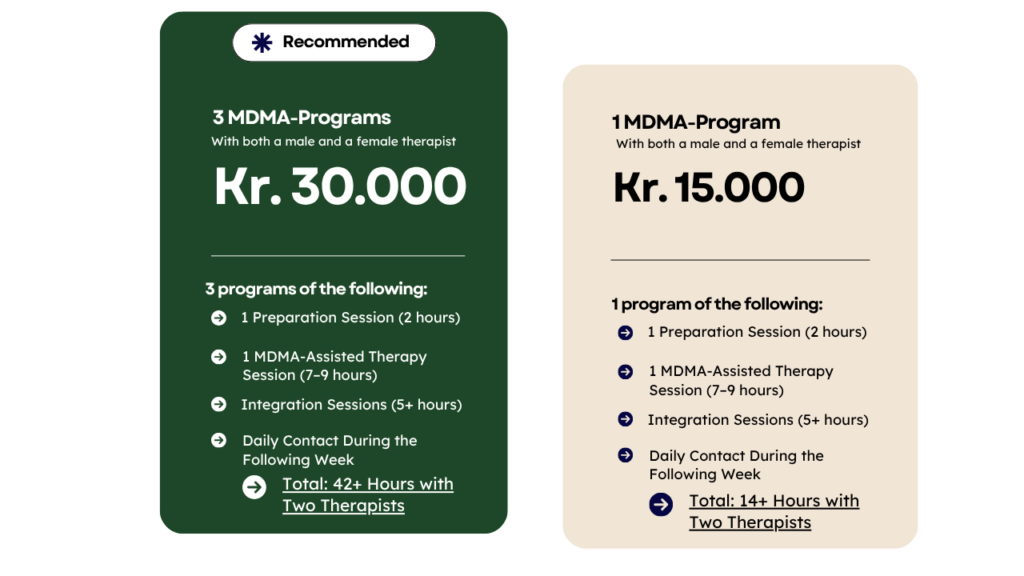
1. Preparation Session (2 hours)
2. MDMA Session (6–8 hours)
3. Integration Session (5+ hours)
4. Daily contact during the following week
Therapeutic Sessions: We recommend adding three therapeutic sessions before the MDMA-Assisted Therapy Program to allow for deeper work during the MDMA session itself. (7.5 hours)
Overview of an MDMA-Assisted Therapy Program
Our approach is informed by the MAPS protokol for the therapeutic use of MDMA, as well as elements of the process described below.
We use MDMA as a supportive element within a longer therapeutic process that includes screening, an introductory consultation, therapeutic preparation sessions, careful preparation, and thorough integration. The goal is to create the best possible conditions for clients to access the underlying causes of unhelpful thought patterns and emotional responses—and to translate these insights into lasting change in everyday life.
Our experience is that the work becomes deeper and more focused from one program to the next. The first MDMA-Assisted Therapy Program often centers on establishing safety, becoming familiar with the state, and developing trust in the process. During the second and third programs, many clients experience easier access to deeper memories, while the integration between programs allows them to work layer by layer. A program consisting of three MDMA-Assisted Therapy Programs therefore typically unfolds over six to nine months, allowing sufficient time for integration, consolidation, and lasting change.
1. Preparation Session: Intention and Direction
The preparation session takes place before the MDMA session and is designed to establish a clear therapeutic direction, allowing the client to enter the session with a strong foundation and thorough inner preparation.
During this session, we work with:
- defining the client’s intention: What does he or she wish to explore, understand, or let go of during the MDMA session?
- clarifying themes and recurring patterns (such as anxiety, shame, emotional stuckness, or relationship conflicts)
- identifying inner protective mechanisms and what typically activates them
- establishing a clear framework of safety, including boundaries, stop signals, personal needs, and therapeutic support during the session
Many clients find that having a clear intention and a well-defined framework makes it easier to enter the process with greater trust and less need for control, creating better conditions for deep therapeutic work.
2. MDMA-Assisted Session: The Therapeutic Work
When the session is facilitated by us as therapists:
The day begins early, as sessions typically last between six and eight hours. We revisit the client’s intention, which has often become more refined since the preparation session.
The client then lies down on a mattress, puts on an eye mask, and we begin the therapeutic work using the intention as our guide. The client remains under the effects of MDMA for approximately four to six hours, during which we use music as a therapeutic tool to support access to memories, bodily sensations, and emotional states. We also use specially composed music created specifically for this form of therapy by Folkman Waves (Spotify & SoundCloud)
We have extensive experience incorporating therapeutic touch when it is appropriate and desired by the client, and we often find that it supports the depth of the therapeutic process. Throughout the session, we provide a calm and reassuring presence—for example, by offering a hand to hold, an embrace, or gentle touch such as stroking the hands or feet.
As the effects of MDMA gradually subside, the client sits up and we briefly discuss the experience. At this stage, we intentionally avoid filling the client with interpretations or extensive conversation, allowing them to remain close to their own subjective experience. Once the client is no longer under the influence of MDMA, they return home.
3. Integration Sessions: Bringing the Experience into Everyday Life
The first integration session takes place the day after the MDMA session and focuses on understanding, integrating, and grounding what has been opened in the body and nervous system. Many clients experience their greatest breakthroughs during this session, making the integration work the following day an essential part of the therapeutic process.
A second integration session is held two to three weeks later. This allows experiences, emotions, and insights to be translated into lasting change and meaningful transformation in everyday life.
An MDMA session without integration and consolidation can easily remain nothing more than an experience—a trip—which serves little purpose when the goal is genuine healing from the past and lasting personal transformation.
4. Daily Contact During the Following Week: Support, Integration, and a Safe Return
Throughout the week following the MDMA session, we maintain daily contact with the client by phone, text message, or email to support the insights and emotions that often continue to emerge after an MDMA-Assisted Therapy session.
Many clients enter a deep process of reflection and journaling after the program. Some benefit from an additional integration session, while others simply appreciate daily therapeutic contact. We pay close attention to each client’s individual needs during this period and regard integration as one of the most important components of the overall MDMA-Assisted Therapy Program.
Please note: In situations where only the integration component is possible, the program will still follow the overall structure described above.
Vores priser
Pricing for MDMA-Assisted Therapy Programs
Note: If you wish to receive integration work only, the cost of the MDMA-Assisted Therapy Session will be deducted from the total price.
Pricing for MDMA-Assisted Therapy Programs
Note: If you wish to receive integration work only, the cost of the MDMA-Assisted Therapy Session will be deducted from the total price.
F&Q
How Is MDMA Produced?
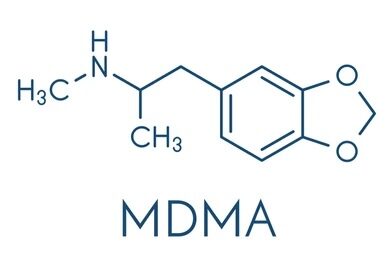
MDMA is a laboratory-produced (synthetic) substance—that is, a single chemical compound rather than a plant or a “mixture.” The abbreviation stands for 3,4-methylenedioxymethamphetamine.
Referencer: (1) https://.euda.europa.eu/publications/european-drug-report/2025/mdma_en
How Does MDMA Differ from Other Amphetamines?
Chemically, MDMA belongs to the amphetamine family, including methamphetamine, but its effects are markedly different. In some respects, MDMA is actually closer to ADHD medications based on dextroamphetamine (d-amphetamine), although MDMA generally has a much stronger empathogenic profile than traditional d-amphetamine. (1)
Referencer: (1) https://medlineplus.gov/druginfo/meds/a601234.html
What Is the Difference Between MDMA and Ecstasy?
MDMA is the name of the active chemical substance: 3,4-methylenedioxymethamphetamine. Ecstasy, on the other hand, is a street name for products sold as “MDMA,” typically in tablet form. In practice, many people use the term “ecstasy” for pills and “MDMA” for crystals or powder, but it is important to understand that the contents are not necessarily the same from one product to another.
The key difference is one of predictability. In clinical research and potential future medical use, pharmaceutical-grade MDMA of known purity and dosage is used. On the illegal market, both “ecstasy” and “MDMA” may be adulterated or contain substances other than those expected, and potency can vary significantly. Therefore, MDMA is a chemical name, whereas ecstasy generally refers to a product with uncertain contents and dosage.
Can You Become Addicted to MDMA?
Most people do not associate MDMA with the same type of physical dependence seen with substances such as opioids or alcohol. For many users, MDMA use is typically occasional rather than daily, and research suggests that MDMA generally has a lower dependence potential than many other psychoactive substances. (1)
Another important point is that MDMA tends to lose much of its subjective effect when used repeatedly within short intervals due to tolerance. This in itself makes it less reinforcing as a daily habit. (2)
The greater risk lies in psychological dependence, where a person begins using MDMA as a way to cope with emotions, chase the experience or “high,” or continues using it despite negative consequences. (3) The purpose of an MDMA-Assisted Therapy Program is therefore precisely that MDMA is not used as a form of self-medication, but rather as a supportive tool within a thorough, professional, and well-integrated therapeutic process.
Referencer:
(1) https://medlineplus.gov/druginfo/meds/a601234.html (2) https://nida.nih.gov/research-topics/mdma-ecstasy-molly?utm_.com (3) https://nida.nih.gov/research-topics/mdma-ecstasy-molly?utm_.com
Is MDMA Legal?
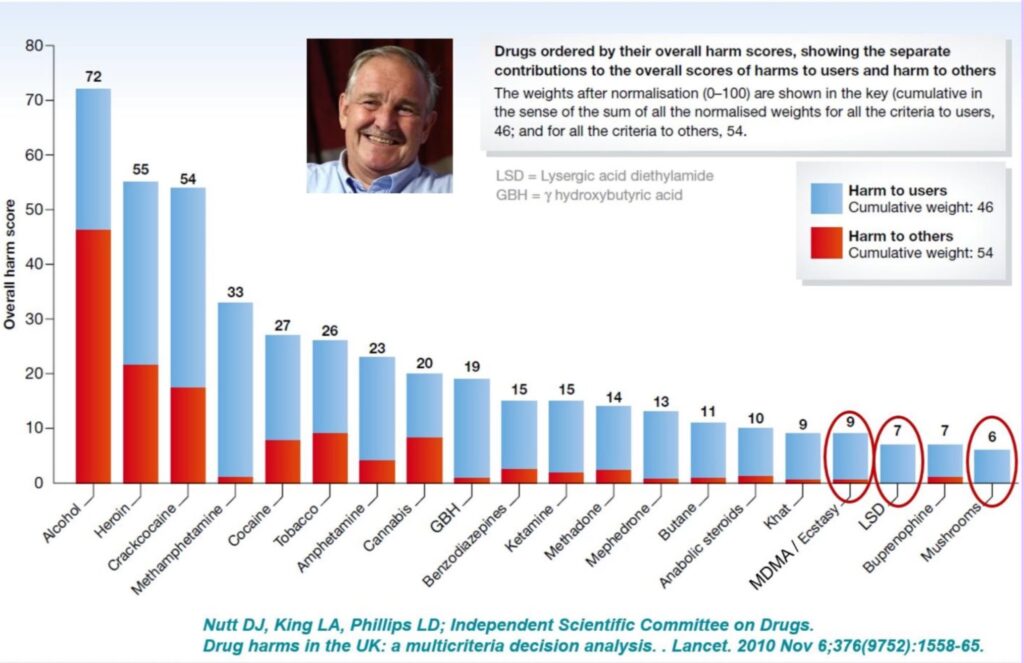
MDMA is illegal in most countries following the prohibition of many psychoactive substances during the 1980s War on Drugs. Since then, therapists and researchers around the world have worked to make MDMA legally available for therapeutic use because of its unique therapeutic potential in trauma treatment and because it is generally regarded as one of the least harmful psychoactive substances—considerably less harmful than alcohol. (See the graph in the section below.)
MDMA Is Legal for Therapeutic Use in the Netherlands and Australia :
In both the Netherlands and Australia, MDMA has been approved for therapeutic use with PTSD patients. (1)
Portugal:
Since 2001, Portugal has decriminalized the personal possession and use of all drugs, including MDMA. This means that personal use is decriminalized, and therapists may support clients in the integration process.
FDA Declines Approval in the United States:
In August 2024, Lykos Therapeutics (the commercial arm of MAPS) received a Complete Response Letter (CRL)from the U.S. Food and Drug Administration (FDA) regarding its application for approval of MDMA-assisted therapy for PTSD. A CRL means that the FDA was unable to approve the application in its current form and requested additional work and data before a future resubmission.
Prior to the decision, the FDA’s Psychopharmacologic Drugs Advisory Committee (PDAC) voted against recommending approval in June 2024, citing several methodological concerns.
Is MDMA Dangerous?
It is important to distinguish between the MDMA used in clinical research and what most people know as “ecstasy” purchased on the street. Street ecstasy or MDMA can vary considerably in content, purity, and dosage, and some tablets may contain substances other than MDMA. This makes the risk profile far less predictable. (1)
Danish Addiction Expert Henrik Rindom on MDMA

Henrik Rindom, one of Denmark’s leading physicians and addiction specialists, has frequently commented on MDMA in Danish media. In interviews with both TV2 and DR, he has stated that pure MDMA, when correctly dosed, is not dangerous. (2)
At the same time, he emphasizes that the greatest practical risks arise from the illegal market, where products may be adulterated with other substances or unknown additives. He advocates a more pragmatic harm-reduction approach, similar to that used in the Netherlands, where drug-checking services and professional guidance can reduce risks while providing users with reliable information about the substances they possess. (3)
Lecture on MDMA at the Danish Medical Society
"MDMA is as Tailor-Made for Trauma Therapy"
n the spring of 2025, we attended a lecture at the Danish Medical Association together with more than 150 Danish physicians and healthcare professionals. The Danish Medical Society had invited two leading researchers to speak about psychedelic therapy, including MDMA.
Professor and consultant neurologist Gitte Moos Knudsen, neurobiologist and clinical neurologist at the University of Copenhagen, presented “Are Magic Mushrooms a Hallucinogenic Trip or a Medicine?” Associate Professor Jesper Andreasen from the Department of Drug Design and Pharmacology presented “MDMA as a Potential Future Psychopharmacological Tool.”
One of the presentations included a graph comparing the harms associated with 21 different psychoactive substances across multiple parameters. Alcohol, heroin, and cocaine ranked among the most harmful, while MDMA was ranked 17th.
The presenters also pointed to MDMA’s relatively low risk of dependence, partly because its subjective effects typically diminish with frequent use. In addition, they highlighted that MDMA generally produces few adverse effects when used appropriately within a suitable clinical setting.
The lecture concluded by describing MDMA as particularly well suited for trauma therapy, summarized in the statement:
“MDMA is as tailor-made for trauma therapy”
Many clinicians and researchers continue to follow developments closely, and there are widespread international expectations that MDMA-assisted psychotherapy may eventually become a legal and regulated treatment option.
Referencer: (1)European Union Drugs Agency (EUDA). (2025). European Drug Report 2025 – MDMA (drug profile/section).(2) https://www.dr.dk/nyheder/indland/misbrugsekspert-mdma-er-farligt-er-en-sandhed-med-modifikationer (3) https://www.dr.dk/nyheder/indland/misbrugsekspert-mdma-er-farligt-er-en-sandhed-med-modifikationer
Has Anyone Died from Taking MDMA?
n clinical studies of MDMA-Assisted Therapy, where screening, medical supervision, and established safety procedures are in place, no deaths have been reported. (1) Danish media have also highlighted that throughout several decades of clinical research in the United States, there have been no reported cases of participants being placed in life-threatening danger within these controlled settings. (2)
The risk increases if MDMA is taken in excessively high doses, but this is a very different situation from a controlled therapeutic setting, where the individual is carefully supported in a safe environment. (3)
It is also important to recognize that many medications currently used in healthcare can carry serious risks if used incorrectly or without proper medical supervision. Similarly, the safety of MDMA depends largely on its purity, dosage, and the context in which it is used. (3)
Deaths associated with MDMA or ecstasy use have been reported, but it is important to understand when and why they typically occur. Clinical reviews show that severe complications and fatalities are most often associated with overheating (hyperthermia) and/or disturbances in fluid and electrolyte balance (hyponatremia), which can lead to seizures and, in the most severe cases, cerebral edema. (3)(4)
This is seen primarily in recreational settings, where common risk factors include:
- High temperatures and prolonged physical activity. (3)
- Disturbances in fluid and electrolyte balance, with hyponatremia being a well-documented complication associated with MDMA. (4)
- Combining MDMA with other substances or consuming products of unknown composition, increasing unpredictability and risk. (3)(5)
Bottom line: Deaths can occur in connection with MDMA or ecstasy use, but they typically involve multiple contributing risk factors. This is precisely why responsible therapeutic settings place such a strong emphasis on careful screening and comprehensive safety procedures. (3)(4)(5)
Reference: (1) Mitchell, J. M., m.fl. (2023). MDMA-assisted therapy for moderate to severe PTSD: a randomized, placebo-controlled phase 3 trial. Nature Medicine. (PubMed) (2) TV 2. (2024). Party drug står på tærsklen til at blive godkendt som lægemiddel. (3) StatPearls. (opdateres løbende). 3,4-Methylenedioxymethamphetamine (MDMA) Toxicity. NCBI Bookshelf.(4) Reviewartikel (PMC). (2025). MDMA-induced hyponatremia (gennemgang af mekanismer og risici).(5) European Union Drugs Agency (EUDA). (2025). European Drug Report 2025, MDMA (drug profile/section).
Why Are Some People Not Suitable for MDMA?
Certain Psychiatric Conditions:
Clinical studies typically exclude individuals with psychotic disorders and often also those with bipolar disorder (particularly where there is a risk of mania or hypomania), because MDMA can increase emotional arousal and alter perception and affect in ways that may be destabilizing. (1)
Significant Cardiovascular Disease:
MDMA can increase both heart rate and blood pressure. Conditions such as uncontrolled hypertension, heart failure, previous heart attack or stroke, and other serious cardiovascular disorders are therefore generally considered contraindications or require careful medical assessment before treatment. (2)
Medications and Drug Interactions:
Combining MDMA with serotonergic medications can increase the risk of serotonin syndrome (“serotonin overload”). This is particularly relevant for certain antidepressants, including SSRIs, SNRIs, MAOIs, and other medications that affect serotonin. (3)
Active Substance Misuse or an Unstable Life Situation:
Many clinical protocols exclude individuals with active substance use disorders and/or unstable living circumstances, as safe treatment and successful integration require a stable foundation. (4)
Pregnancy and Breastfeeding:
As a precaution, pregnancy is generally considered an exclusion criterion in clinical settings because there is insufficient safety data to recommend exposure during pregnancy. This is standard practice in many clinical drug studies and treatment protocols. (5)
Referencer: (1) https://pmc.ncbi.nlm.nih.gov/articles/PMC11387902/?utm.com (2) https://government.nl/documents/reports/2024/05/31/mdma-beyond-ecstasy (3) https://pmc.ncbi.nlm.nih.gov/articles/PMC9177763/?utm.com * Man bør aldrig stoppe eller ændre medicin på egen hånd, men altid i dialog med ordinerende læge. (4) https://pmc.ncbi.nlm.nih.gov/articles/PMC11387902/?utm.com (5) https://cdn.clinicaltrials.gov/large-docs/59/NCT04714359/Prot_000.pdf?utm.com
What Does It Feel Like to Be Under the Influence of MDMA?
In an MDMA-Assisted Therapy Program, the therapeutic setting and professional support play a crucial role in shaping both the experience itself and how it is safely integrated afterward.
The experience varies considerably from person to person, but many describe MDMA as a temporary state of increased emotional openness and a greater sense of safety in connecting with both themselves and others.
Most people remain fully aware of their surroundings and know that they are participating in an MDMA session. At a medical conference in 2025, Associate Professor Jesper Andreasen remarked that a person could even write an article while under the influence of MDMA. We would lower the ambition slightly and simply say that you could make yourself a cup of coffee.
Typical experiences include:
- feeling greater warmth, calmness, and trust, often accompanied by increased self-compassion and reduced self-criticism
- becoming more open and talkative, making it easier to express difficult thoughts and emotions
- experiencing a stronger sense of emotional connection, empathy, and closeness
- feeling more connected to the body without becoming overwhelmed
- becoming more aware of bodily sensations, such as waves of energy, trembling, or sensations of warmth and cold
- experiencing enhanced sensory perception, with music often feeling especially moving or meaningful
Less pleasant or more intense experiences may also occur, including:
- restlessness, physical tension, or jaw tension
- nausea, although this is uncommon and is most often seen in individuals with particularly strong psychological defenses
- periods of emotional intensity, during which old memories or unresolved themes may emerge
Most people experience the effects in waves, with an initial onset, a more stable middle phase, and a gradual winding down during which they often become quieter and more tired.
In the days that follow, some people feel physically sore, tired, or emotionally sensitive, while others feel lighter, calmer, and mentally clearer. This is why integration and adequate rest are considered essential components of therapeutic MDMA use.
Hvad skal jeg være opmærksom på, hvis jeg ønsker MDMA-Assisteret Terapi?
Hvis du overvejer MDMA-Assisteret Terapi, er det vigtigt at vælge en ramme, hvor sikkerhed, etik og kvalitet er tydeligt prioriteret. Her er de vigtigste ting at være opmærksom på:
- To terapeuter til stede (mand og kvinde): Det giver ofte en stærkere oplevelse af tryghed, balance og spejling – og det øger sikkerheden, hvis der opstår svære processer undervejs.
- Renhed og kvalitet af stoffet: Sørg for, at MDMA er testet for renhed og at der er fuld transparens om, hvad der arbejdes med. Uforudsigeligt indhold i gadeprodukter er en væsentlig risikofaktor.
- Trygge og professionelle rammer for sessionen: En MDMA-session bør foregå i et roligt, stabilt og afskærmet rum med god tid, klare aftaler, tydelige grænser og mulighed for pauser. “Set & setting” betyder meget for både sikkerhed og udbytte.
- Terapeuterne skal kende din historie: Det er afgørende, at behandlerne ikke møder dig “koldt”, men har sat sig grundigt ind i din baggrund, dine mønstre, dine triggere og dine ressourcer. Derfor bør der altid være terapeutiske optaktsessioner før MDMA-sessionen og grundig integration efter.
Indgående screening af dig og dine omstændigheder: Professionel praksis indebærer, at terapeuterne laver en grundig screening af helbred, medicin, psykisk stabilitet og livsomstændigheder – og aktivt sikrer, at du ikke er i en risikogruppe. (Læs mere ovenfor under “Hvorfor er der nogen, der ikke må tage MDMA?”).
Når disse elementer er på plads, bliver MDMA ikke en “genvej”, men et redskab der kan støtte en terapeutisk proces, hvor forberedelse, rammer og integration er det, der gør forskellen.
Hvad kan der ske, hvis ikke faciliteringen er forsvarlig?
Hvis faciliteringen (rammerne + forberedelsen + den terapeutiske støtte + integrationen) ikke er tilstrækkelig, kan MDMA-sessionen i værste fald blive uvirksom, overvældende eller direkte skadelig, fordi tilstanden kan åbne for for meget materiale på én gang, og fordi det kræver dygtig regulering og efterarbejde.
Her er de mest typiske faldgrubber:
- Overvældelse og retraumatisering: Uden en tryg ramme kan gamle minder og kropslige reaktioner komme så kraftigt, at personen føler sig væltet omkuld i stedet for hjulpet. Det kan forstærke angst, dissociation eller alarmberedskab bagefter.
- Manglende integration (“stor oplevelse – ingen forandring”): Hvis der ikke er grundig integration i tiden efter MDMA-sessionen, kan sessionen ende som en intens oplevelse uden varig effekt, eller skabe forvirring, utryghed og uro efterfølgende, fordi oplevelserne ikke bliver forstået og forankret.
- Forkert støtte i rummet: For meget styring, for lidt støtte, eller støtte, der ikke er afstemt, kan få klienten til at tilpasse sig terapeuten, miste kontakt med sin egen proces, eller føle sig styret. I en MDMA-tilstand kan subtilt pres føles ekstra stærkt.
- Vigtigt med en mandlig og kvindelig terapeut under sessionen: Det er helt afgørende, at der er både en mandlig og kvindelig terapeut i rummet, på en MDMA-session. Under påvirkning af MDMA kommer man nemlig i kontakt med de oplevelser man har haft, med de to køn. Disse oplevelser bliver således forstærket når der er repræsentant for hvert køn i rummet eller helt holdt tilbage, hvis den ene part mangler.
- Grænseoverskridelser og uklare aftaler: Hvis der ikke er helt tydelige samtykke-aftaler (fx om berøring, pauser, stop-signal), kan klienten efterfølgende sidde med ubehag eller oplevelse af at være blevet “taget” i stedet for støttet.
- Utilstrækkelig screening og medicinsk risikovurdering: Hvis man ikke gennemgår helbred, medicin og psykiatrisk historik grundigt, kan man øge risikoen for uønskede reaktioner (fx interaktioner med serotonerge lægemidler, stærke efterreaktioner eller destabilisering).
- Utryg setting eller praktiske forhold: Stress, støj, afbrydelser eller et rum, der ikke føles sikkert, kan fastholde forsvarssystemet og øge risiko for, at sessionen bliver urolig og mindre terapeutisk.
En god tommelfingerregel er: Jo mere “åbent” et menneske kan blive i en MDMA-session, jo vigtigere er det, at rammen er professionel, samtykkebaseret og integrerende. Det er netop derfor, seriøse forløb koster en del og lægger stor vægt på forberedelse, facilitetering og integration -ikke på stoffet alene.
Hvorfor er det vigtigt, at der både er en mandlig og en kvindelig terapeut tilstede?
At der både er en mandlig og en kvindelig terapeut til stede under MDMA-session, kan have en meget afgørende betydning for, hvad klienten kommer i kontakt med under sessionen. Under påvirkning af MDMA kommer man i kontakt med oplevelser og erindringer, som ofte trigges af de to køn som er repræsenteret i rummet. Ofte ser vi, at klienten får nye oplevelser eller minder når den ene terapeut forlader rummet, eller kommer ind i rummet.
På samme måde kan en klient fx søge den nødvendige tryghed og nærhed hos den kvindelige terapeut (mor), når han/hun er inde og undersøge oplevelser med far, en evt. overgrebsmand eller det mandlige køn generelt. Er begge køn ikke repræsenteret under sessionerne, vil man ikke få mulighed for at tilgå det fulde potentielle “materiale” ligesom man heller ikke vil kunne give klienten mulighed for at søge tryghed hos den mandlige (far) eller kvindelige (mor) terapeut.
Hvor kan jeg læse mere om MDMA?
Hvis du ønsker at studere MDMA-Assisterede Terapi yderligere, så kan vi anbefale dig at holde øje med den internationale organisation MAPS, da de er de førende inden for emnet.
Vi vil også løbende dele seneste nyt her på siden.
Samlede Reference-bibliotek
Videnskabelige artikler og faglige oversigter
Myndigheder, institutioner og vidensressourcer
Aalborg Universitetshospital. (2025, 20. november). DFF giver 5,8 mio. kr. til psykiatriforskning.
European Union Drugs Agency. (2025). European Drug Report 2025, MDMA (drug profile/section).
MedlinePlus. (n.d.). Drug information (a601234).
National Institute on Drug Abuse. (n.d.). MDMA (Ecstasy/Molly).
Rapporter og protokoller
Government of the Netherlands. (2024, 31. maj). MDMA beyond ecstasy.
ClinicalTrials.gov. (n.d.). Protocol document for NCT04714359
Danske medier
Videoer
Pollan, M. (2018/2022). How to Change Your Mind (bog og Netflix-dokumentarserie). Dokumentarserien er baseret på Michael Pollans bog; instruktører: Lucy Walker og Alison Ellwood.
Smith, J. (2018). The Agony and the Ecstasy: How MDMA is being used to treat PTSD (The Economist video). Instruktør: Joe Smith; udgiver: The Economist.
Huberman, A. (2023). The Science of MDMA & Its Therapeutic Uses: Benefits & Risks (Huberman Lab). Neuroforsker (PhD) og professor ved Stanford School of Medicine; solo-episode med Andrew Huberman som vært/forfatter.
Frost, I & Søndergaard, J-B (2026). MDMA-Assisteret Terapi og traumeforløsning forklaret. Samtalerne er baseret på egne erfaringer og observation.
Frost, I & Søndergaard, J-B (2025). MDMA-Assisteret Terapi og arbejdet med narcissistiske træk.Samtalerne er baseret på egne erfaringer og observation.
Rights and Sharing
The texts, wording, structure, images, graphics, videos, testimonials, client stories, and other original material on this website have been created by us and belong to us. You are very welcome to share and quote our content, provided that you clearly credit this website as the source.
Disclaimer
The content on this page is provided for informational purposes only. It does not constitute medical advice and cannot replace assessment, diagnosis, or treatment by a licensed healthcare professional. We do not provide legal advice.
Information – Not Encouragement:
This page does not encourage the acquisition, possession, or use of illegal substances. We do not provide advice on the illegal acquisition, possession, dosage, or use of controlled substances.
Research and Experience:
When we refer to research, we describe general findings and frameworks from published sources. When we share personal experiences and client testimonials, these reflect individual experiences and do not guarantee results.
No Guarantee of Effectiveness:
MDMA-Assisted Therapy does not guarantee symptom relief or recovery. Its effects, process, and outcomes vary from person to person and depend on multiple factors, including preparation, setting, and integration.
Safety and Suitability:
MDMA is not suitable for everyone. We assess and screen health conditions, medications, and individual life circumstances. No one should change or discontinue prescribed medication without consulting the prescribing physician.
Medication:
Information regarding medications and interactions is general in nature. If you are taking antidepressants, anti-anxiety medication, or any other medication, this should always be assessed individually in consultation with the prescribing physician.
Practical Framework:
We describe our approach and therapeutic framework in general terms. We do not provide instructions that could be used to conduct sessions without professional facilitation.